Netflix reduced the subscriber sample size required to reach 95% statistical power by over 100x by inserting a team draft interleaving stage ahead of traditional A/B tests. As homepage rankers powering rows like Top Picks and Trending Now across more than 100 million members matured, detecting incremental wins on retention or total streaming hours required ever-larger cells and months of runtime. In their 2017 engineering post, Joshua Parks, Juliette Aurisset, and Michael Ramm show how blending two rankers into the same member’s row turns noisy between-user comparisons into sensitive within-user measurements that prune weak candidates in days.
- Over 100x fewer users for 95% power: In a parallel validation comparing two rankers of known relative quality (
ranker B > ranker A), bootstrap subsampling showed interleaving needed over 100x fewer subscribers than even Netflix’s most sensitive algorithm-specific engagement A/B metric to drop error probability from 50% to 5%. - Two-stage funnel cuts test cycles to days: Stage 1 interleaving rapidly screens a broad pool of ranking ideas down to top contenders in a matter of days, reserving costly Stage 2 A/B tests for long-term retention and total streaming hours.
- Equal weight per member eliminates power-user skew: Measuring each subscriber’s share of hours viewed within an interleaved row prevents a small fraction of heavy streamers from dominating group variance.
- Strong alignment with A/B winners: Across multiple candidate rankers evaluated against the production control, interleaving preference lifts correlated strongly with Netflix’s most sensitive A/B engagement metric.
How repeated measures and team draft work
Netflix explains the sensitivity jump using a blind Coke-vs-Pepsi taste test. Splitting people into two separate groups (between-subject A/B testing) injects massive noise from baseline consumption habits: heavy soda drinkers are a small share of the population yet dominate total ounces consumed, so any slight split imbalance skews the result. Switching to a repeated-measures design gives each person unlabeled access to both drinks and compares each individual’s fractional preference, cancelling baseline variation and capping heavy-user leverage.
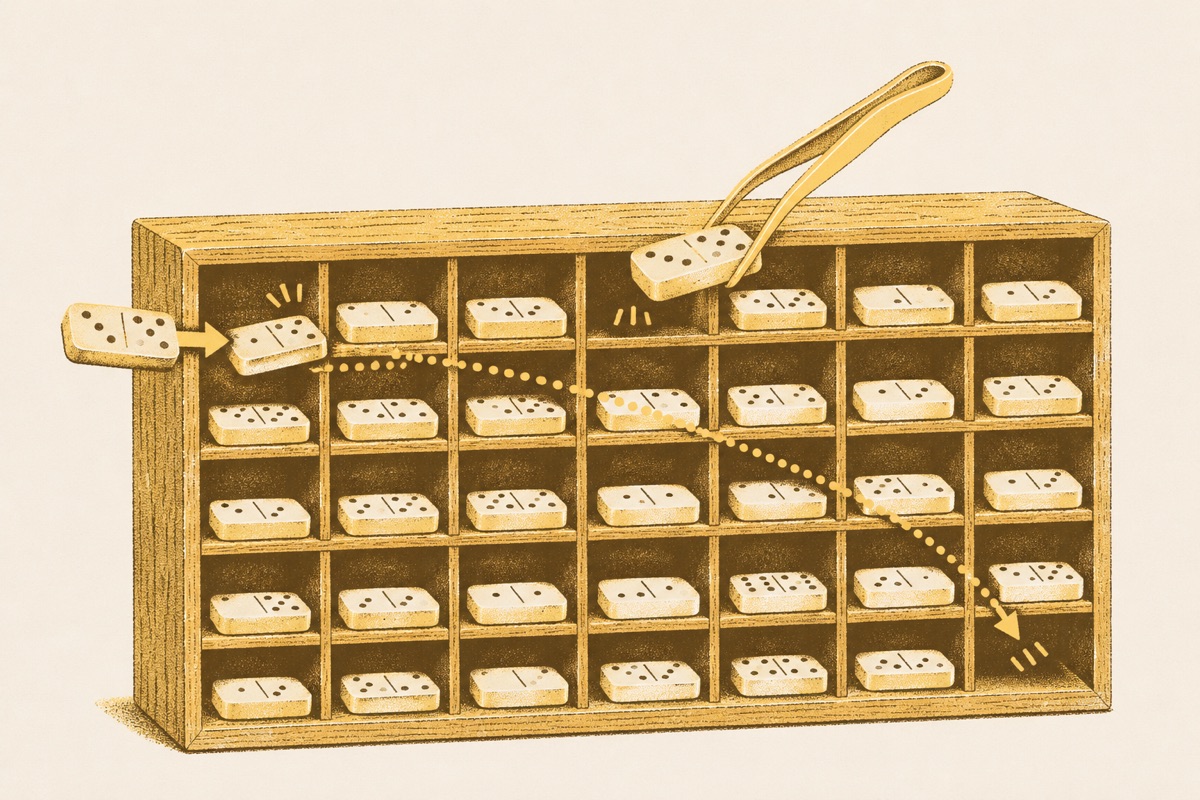
Applying repeated measures to a Netflix homepage row requires handling position bias, because play probability drops steadily from left to right. Simply appending ranker B after ranker A would let slot position overwhelm ranker quality. Netflix uses a variant of team draft interleaving (citing Chapelle et al.):
- Flip a fair coin to decide whether ranker A or ranker B drafts first for that impression.
- Each ranker alternates picking its highest-ranked video not yet placed in the row, removing duplicates while guaranteeing equal slot-position likelihood for both rankers.
- Attribute each member’s viewing hours inside that row back to whichever ranker drafted the played title, and compare shares across rankers.
Sensitivity and A/B alignment results
To test whether interleaving actually accelerates experimentation without misleading teams, Netflix ran an interleaving test alongside a classic A/B test on two rankers with known ordering (ranker B > ranker A), using bootstrap subsampling (N users in interleaving versus N / 2 per A/B cell). Plotting error probability against sample size showed interleaving crossed the 95% power threshold (5% disagreement rate) with over 100x fewer subscribers than even Netflix’s most sensitive algorithm-specific A/B metric, and dramatically fewer than overall streaming hours.
Next, Netflix plotted interleaving preference lifts against Stage 2 A/B lifts across a suite of experimental rankers tested against the production control. The strong positive correlation confirmed that ranking changes that win interleaved head-to-heads reliably predict wins in full-cohort A/B tests, similar to how offline-online gaps push ranking teams at YouTube and Hulu to rely on live validation.
Caveats and builder takeaway
- Relative preference cannot measure retention or page-level shifts: Interleaving only scores which ranker’s items win share inside a blended row. It cannot detect if an algorithm lifts or harms overall session starts, total streaming hours, or month-to-month retention, making Stage 2 A/B confirmation mandatory.
- High engineering and business-logic friction: Blending two live rankers in production creates subtle interactions with deduplication, row-level business rules, and caching, forcing Netflix to build automated consistency checks and anomaly detection.
- No raw sample counts or correlation coefficients published: The 2017 post presents normalized sensitivity curves and scatter plots without disclosing exact
Nthresholds,R^2correlation numbers, or how tied/shared items in overlapping top-1 lists affect credit variance. - Credit rules favor ranker differences: When rankers A and B agree on a top title, whoever wins the coin toss gets the draft credit (leaving only non-overlapping picks to differentiate quality), and whole-page two-stage retrieval changes that alter candidate diversity across rows still need cohort A/B tests.
If your ranking team is bottlenecked by multi-week A/B queues on mature feeds, adopt Netflix’s two-stage funnel: use team draft interleaving to kill bad rankers in days, then spend full A/B traffic only on the surviving finalists.