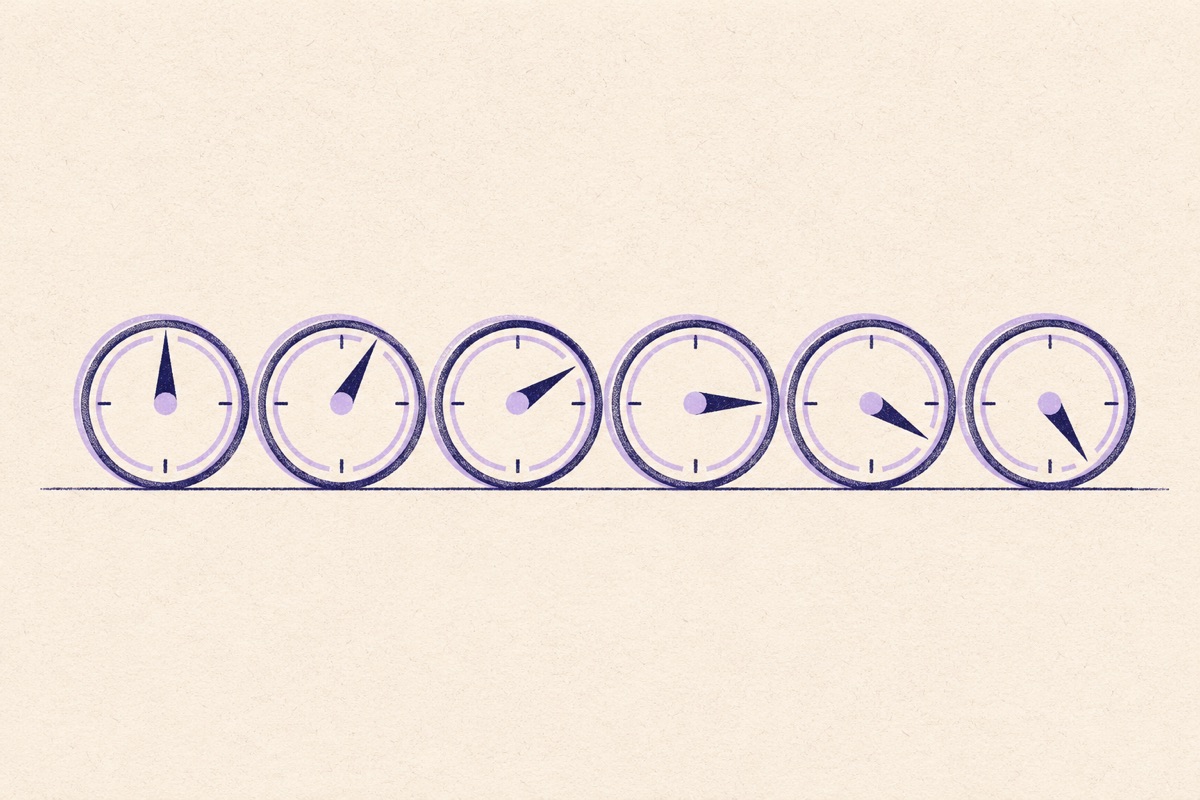
Rotary Position Embedding (RoPE) gives self-attention an exact relative distance signal simply by rotating pairs of query and key coordinates by multiples of their absolute token index. Introduced by Jianlin Su, Yu Lu, Shengfeng Pan, Ahmed Murtadha, Bo Wen, and Yunfeng Liu in the RoFormer paper, RoPE replaced additive position vectors with an orthogonal rotation matrix R^d_{Theta, m} so that the inner product q_m^T k_n collapses into x_m^T W_q^T R^d_{Theta, n - m} W_k x_n, a function strictly of the token embeddings and the offset n - m.
That algebraic trick solved a split that had divided the original Transformer and later relative-attention models. Learned absolute tables failed past their training length limit, while relative attention biases injected pairwise scores that broke O(N) linear-attention kernels. By encoding position multiplicatively on queries and keys without touching values or adding a dense bias matrix, RoPE became the default position mechanism across modern open-weight language models, from LLaMA and Qwen to DeepSeek-V2’s decoupled attention keys.
- Pure relative dot product: rotating
W_q x_mbym * theta_iandW_k x_nbyn * theta_iguarantees the attention score sees only(n - m) * theta_i, with zero extra parameters. - 27.5 vs 27.3 BLEU on WMT 2014 English-to-German translation (4.5M pairs) alongside faster masked language modeling convergence than BERT at 100K steps.
- +1.50 points on long legal matching: on Chinese CAIL2019-SCM triplets (>512 characters), RoFormer-1024 reaches 69.79% test accuracy vs 68.10% for WoBERT-512 and 67.77% for BERT-512 (while GLUE results are mixed: up on MRPC, STS-B, and QQP, down on SST-2, QNLI, and MNLI).
- Drop-in compatibility with linear attention: because rotation preserves vector norms, adding RoPE to a 12-layer Performer on Enwik8 lowers language-modeling loss while keeping
O(N)complexity intact.
Why additive and bias-based encodings break
Self-attention by itself is permutation-equivariant: shuffle the input tokens and the output vectors shuffle identically. Prior to RoPE, Transformers injected order in two camps, and Section 2 of the RoFormer paper shows where each camp breaks down.
The first camp adds a position vector p_i directly to each token embedding before multiplying by W_q, W_k, and W_v. If p_i comes from a learned lookup table of size L, the model cannot even address position L + 1 at inference time. Even if p_i uses Vaswani et al.’s continuous sinusoids, expanding the attention logit q_m^T k_n produces four cross-terms (Equation 6): content-to-content (x_m^T W_q^T W_k x_n), content-to-position, position-to-content, and position-to-position (p_m^T W_q^T W_k p_n). Those cross-terms mix absolute coordinates with semantic projections through dense weight matrices, leaving no guarantee that shifting both tokens by +10 produces the same positional interaction.
The second camp tries to repair Equation 6 by replacing absolute terms with relative embeddings or score biases. Shaw et al. inject trainable relative key and value embeddings clipped at a maximum distance r_max, discarding exact ordering beyond that window. Transformer-XL swaps p_n for sinusoidal relative vectors and introduces shared bias vectors u and v. T5 simplifies the whole position term into a scalar lookup b_{i,j} added directly to the N x N logit matrix (a cousin of ALiBi’s linear distance penalties).
All of those additive relative schemes share a structural flaw: they alter the pairwise interaction inside the N x N score matrix rather than transforming the standalone query and key vectors. Once position lives inside an N x N bias table or pairwise key offset, you can no longer factor attention as phi(q_m)^T (sum varphi(k_n) v_n^T) in O(N) kernelized linear attention such as Performer.
Deriving rotation from a single inner-product constraint
Su and colleagues start from the property they want rather than guessing an architecture. In Section 3.1, they demand a pair of position-encoding functions f_q(x_m, m) and f_k(x_n, n) whose inner product equals some function g(x_m, x_n, m - n) that depends only on the two embeddings and their offset.
In two dimensions (d = 2), any vector is a complex number ||q|| e^{i theta_q}. Writing f_q and f_k in polar coordinates (Section 3.4.1) and setting m = n with unpositioned initial vectors at index 0 forces two constraints: the radii R_q and R_k cannot depend on position (||q|| and ||k|| stay constant), and the position angles must form an arithmetic progression phi(m) = m * theta. Multiplying by e^{i m theta} in the complex plane corresponds directly to a 2 x 2 rotation matrix on real coordinates (x_1, x_2): [x_1 cos(m theta) - x_2 sin(m theta), x_1 sin(m theta) + x_2 cos(m theta)].
To scale from d = 2 to any even head width d, RoPE slices the vector into d / 2 independent 2D pairs and applies a block-diagonal rotation R^d_{Theta, m} with theta_i = 10000^{-2(i - 1)/d} (Equation 15). Because every 2 x 2 block is orthogonal, multiplying R^d_{Theta, m} on the query and R^d_{Theta, n} on the key satisfies (R^d_{Theta, m})^T R^d_{Theta, n} = R^d_{Theta, n - m}. Computing the sparse product via Equation 34 takes only two O(d) Hadamard operations: (x * cos(m Theta)) + (x_swapped * sin(m Theta)), where x_swapped = [-x_2, x_1, -x_4, x_3, ...].
Three consequences follow directly from the math:
- Norm preservation: Rotation never stretches or shrinks
qork, avoiding hidden-state magnitude drift across layers. - Long-term decay: Using Abel summation on the
d/2rotating pairs (Equation 37), the paper bounds the inner product by a sum of complex exponentials|S_{i+1}|whose upper bound falls from roughly20at short offsets toward8by distance250. Early pairs spin rapidly to separate adjacent tokens; late pairs spin slowly to preserve long-range comparisons. - Linear attention: In Performer (
Attention_m = sum phi(q_m)^T varphi(k_n) v_n / sum phi(q_m)^T varphi(k_n)), applyingR^d_{Theta, m}tophi(q_m)andR^d_{Theta, n}tovarphi(k_n)injects relative distance into the numerator while keeping the denominator positive and associative, preservingO(N)scaling (Equation 19).
Trace a rotation step and compare four position schemes
Suppose a 4-dimensional query q = (1, 0, 1, 0) sits at position m = 3 and a key k = (1, 0, 1, 0) sits at position n = 8, with fast plane theta_1 = 1.0 rad/token and slow plane theta_2 = 0.01 rad/token. The query rotates by (3.0, 0.03) radians and the key rotates by (8.0, 0.08) radians; their dot product sums cos(8.0 - 3.0) + cos(0.08 - 0.03) = cos(5.0) + cos(0.05) = 0.284 + 0.999 = 1.283. Shift both tokens ten positions forward to m = 13 and n = 18: the absolute angles jump to 13.0 and 18.0, yet the gap n - m = 5 and the dot product 1.283 remain identical.
Switch through the four tabs below to compare how RoPE stacks up against the major baselines tested or analyzed in the paper.
Select a position scheme (or use Left and Right arrow keys) to compare its formulation, failure mode, and RoFormer's measured benchmark tradeoffs.
Trainable absolute position vectors (BERT, GPT)
AdditiveAdds a learned embedding p_i from a fixed lookup table 1..L to every input token before projection.
- Why it breaks
- Hard limit at max length L: sequences longer than 512 in BERT or WoBERT must be truncated or have no trained embeddings.
- RoPE contrast
- RoPE computes rotations analytically for any integer index m without storing or capping a position table.
- Measured evidence
- On CAIL2019-SCM (>512-char legal cases), BERT-512 scores 67.77% and WoBERT-512 scores 68.10%, while RoFormer-1024 reaches 69.79%.
- Mixed GLUE caveat
- At seq length 512 (Table 2), BERT still beat RoFormer on SST-2 (93.5 vs 90.7), QNLI (90.5 vs 88.0), and MNLI (84.6 vs 80.2).
Fixed sinusoidal addition (Vaswani et al. 2017)
AdditiveAdds fixed sine/cosine waves to token embeddings before W_q, W_k, and W_v projections.
- Why it breaks
- Expands q_m^T k_n into four mixed terms where W_q and W_k couple absolute position vectors directly with word semantics.
- RoPE contrast
- Moves sinusoids from addition into block-diagonal multiplication on Q and K after projection, leaving V untouched.
- Measured evidence
- On WMT 2014 EN-DE (Table 1), RoFormer improves test BLEU from 27.3 to 27.5 under identical fairseq training settings.
- Pretraining speed
- Replacing BERT's sinusoidal/absolute position block with RoPE produced noticeably faster MLM loss convergence over 100K steps.
Relative attention biases (T5, Shaw et al., Transformer-XL)
Matrix-levelModifies attention logits using clipped relative offsets or learned pairwise bias scalars b_{i,j}.
- Why it breaks
- Couples position into the N x N logit matrix, which cannot be factored cleanly inside O(N) kernelized linear attention.
- RoPE contrast
- Transforms each query and key vector independently before inner product, keeping Q and K separable for kernel tricks.
- Measured evidence
- On Enwik8 (12-layer Performer, seq len 1024), adding RoPE drives faster convergence and lower LM loss at O(N) attention cost.
- Numerical note
- In linear attention (Eq. 19), RoPE rotates only the numerator terms because rotating the denominator could cause division by zero.
Rotary Position Embedding (RoFormer)
MultiplicativeRotates d/2 coordinate planes of Q and K by m * theta_i so inner products depend purely on offset m - n.
- Strengths
- Zero learned position parameters, norm-preserving orthogonality, O(d) execution via Hadamard products, and natural long-term decay.
- GLUE highlights
- Outperforms BERT on MRPC (89.5 vs 88.9), STS-B (87.0 vs 85.8), and especially QQP (86.4 vs 71.2) at 512 tokens.
- Pretraining ramp
- Multi-stage Chinese pretraining raises validation accuracy from 65.0% (len 512) to 67.4% (len 1536) as context expands.
- Open gap
- Section 4.5.5 notes the paper still lacks a formal explanation for why RoPE converges faster and generalizes better on long text than peers.
Source: Su et al. (2021), Sections 2 through 4 and Tables 1 through 5.
If you prefer the summary without clicking through each tab, the four schemes trade off cleanly:
- Learned absolute tables break whenever inference exceeds the trained table limit
L(capping BERT and WoBERT at 512 tokens on CAIL2019-SCM while RoFormer-1024 reaches 69.79%), though BERT still beat RoFormer on three of six GLUE tasks at 512 tokens. - Sinusoidal addition leaks four noisy content-position cross-terms into attention logits, whereas RoPE raises WMT14 EN-DE from 27.3 to 27.5 BLEU and converges faster in MLM pretraining.
- Pairwise relative biases work inside standard softmax attention but materialize
N x Ninteractions that breakO(N)linear kernels; RoPE drops directly into Performer on Enwik8. - RoPE itself unifies relative distance, norm preservation, and
O(d)speed without learned position weights, though its authors explicitly flag unexplained gaps in why it speeds convergence.
Caveats and how RoPE evolved after 2021
Two caveats in the original paper matter whenever engineers evaluate RoPE today. First, the empirical wins in the paper are mixed rather than universal. On GLUE (Table 2), RoFormer scored substantially higher on QQP (86.4 vs 71.2) and edged out BERT on MRPC and STS-B, yet fell behind BERT by 2.5 to 4.4 points on SST-2, QNLI, and MNLI. Second, the authors themselves caution in Section 4.5.5 that their theory is incomplete: orthogonal 2D rotation proves exact relative-offset dependence and an upper bound that decays with distance, but does not explain why RoPE converges faster or beats competing relative encodings that also exhibit decay.
More practically for modern LLM builders, an analytical formula for any position m does not mean free length extrapolation. Generating angles at m = 32,768 for a model trained at 4,096 exposes high-frequency pairs to combinations of relative phases never encountered during training, collapsing perplexity. That limitation sparked two follow-on techniques now standard in production: Position Interpolation, which compresses m down into the trained window via m / scale, and YaRN, which separates high-frequency local pairs from low-frequency global pairs before scaling attention logits. Even newer architectures like DeepSeek-V2 and V3 keep RoPE alive inside compressed latent attention only by isolating a small decoupled key k_t^R specifically to carry rotary angles alongside linearly biased or compressed keys.
For engineers choosing or tuning positional encodings today, the takeaway is straightforward: RoPE earned its dominance not through magic long-context extrapolation out of the box, but because a parameter-free O(d) coordinate rotation cleanly preserves vector norms, keeps KV-cache math decoupled from fixed sequence limits, and composes cleanly with every downstream context-extension trick built since.


