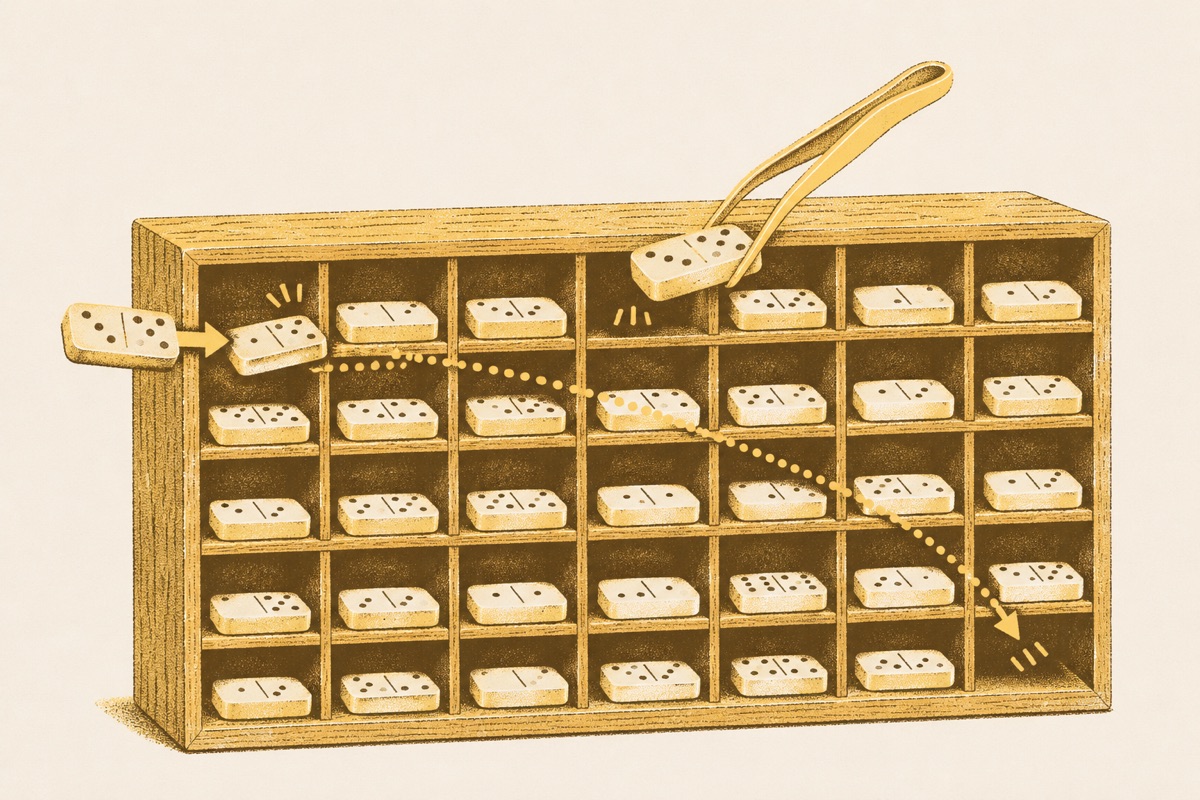
Jaime Carbonell and Jade Goldstein introduced Maximal Marginal Relevance (MMR) in 1998 to solve a persistent search failure: pure relevance ranking fills the top slots with near-duplicate passages once a corpus grows redundant. Instead of scoring each item in isolation, MMR greedily picks the candidate that maximizes a linear combination of query similarity and novelty relative to items already chosen. In the May 1998 SUMMAC evaluation of 15 summarization systems, their MMR summarizer posted the highest query-relevant F-score (0.73) and highest informative question-answering accuracy (70%), while 80% of users in a blind pilot study chose MMR over standard relevance ranking.
- Top SUMMAC evaluation scores:
MMRled 15 competing systems with 0.73 F-score on topic-relevance summaries and 70% accuracy on informative question-answering summaries. - No precision penalty on single documents: On 50 TIPSTER articles judged by three CMU assessors, shifting the diversity weight from
lambda = 1(pure relevance) tolambda = 0.3kept 10%-length precision at 0.74 to 0.78 (TREC + CMU) and 0.79 to 0.83 (CMU), with no statistically significant drop. - Beats lead sentences on longer summaries: At 25% document compression,
MMRheld 0.73 to 0.76 sentence precision acrosslambdavalues, outperforming the lead-sentence baseline (0.60 TREC + CMU, 0.65 CMU). - 80% user preference in blind testing: Four of five undergraduate testers picked
MMRover pure relevance for a search task, and three discovered a two-stage strategy combining low and highlambda.
How marginal relevance reranking works
Conventional information retrieval systems return a ranked list R = IR(C, Q, theta) ordered purely by query similarity above a cutoff theta. That works well when relevant documents are scarce or exhaustive recall is required. In large, repetitive collections such as news streams or retrieval-augmented generation chunks, the top ten results often repeat the same core fact.
MMR replaces static list sorting with greedy sequential selection. Starting from an empty selected set S, each step picks the remaining document D_i in R \ S that maximizes:
MMR = arg max [ lambda * Sim_1(D_i, Q) - (1 - lambda) * max_{D_j in S} Sim_2(D_i, D_j) ]
Here Sim_1 scores query-document relevance, while Sim_2 scores similarity against the closest item already placed in S. Notice that Sim_1 and Sim_2 do not have to be the same metric: a dense cross-encoder or late-interaction retriever can supply Sim_1, while cheap cosine overlap or shingle distance supplies Sim_2. Setting lambda = 1 recovers standard relevance ranking; setting lambda = 0 maximizes pure pairwise diversity inside R.
Key findings from search and summarization
In a blind user study with five undergraduates comparing standard ranking (“method R”) against MMR (“method S”), the authors found that users did not want a fixed diversity weight. They preferred a two-phase search workflow:
Three of the five study participants discovered this split naturally, favoring MMR for navigating unfamiliar topics and pure relevance once they narrowed into a sub-band. Four of five (80%) picked MMR when given free choice on the final search task.
For summarization, Carbonell and Goldstein segmented single documents into sentences, reranked them with cosine MMR against a query, and displayed the selected sentences in original document order. On the 50-article TIPSTER audit, diversity came almost free: lambda = 0.3 matched lambda = 1 at 25% length (0.74 TREC + CMU, 0.76 CMU) because replacing a redundant top sentence occasionally uncovered a missed relevant fact. The authors emphasize that gains grow with document length and peak in multi-document news summarization, where top-10 pure-relevance passages routinely contain duplicate background sentences.
Caveats and builder takeaway
- Tiny user study and unstandardized SUMMAC controls: The retrieval experiment tested only five undergraduates without significance tests, and the authors explicitly warn that SUMMAC systems varied in summary length, making the
0.73F-score and70%accuracy indicative rather than definitive. - No multi-document benchmark table: Although the paper argues
MMRshines brightest across document clusters, its quantitative table covers only single-document TIPSTER sentences; multi-document gains are reported qualitatively. - Pairwise max misses linear combinations: Comparing each candidate only against its single closest selected neighbor can overlook when a third item is already covered by a blend of two earlier picks, a gap later solved in sub-2ms by Determinantal Point Processes (
DPP) (which nearly doubledMMR’s watch-minute lift in Hulu’s A/B test). - Candidate pool and similarity ceiling: Because
MMRonly reordersR, upstream retrieval (whether sparse, dense, or merged via Reciprocal Rank Fusion) must surface subtopic diversity first.
MMR remains the simplest, dependency-free baseline for RAG context packing and search reranking: keep lambda near 0.5 to 0.7, pass a well-calibrated similarity function Sim_2, and only reach for DPP if pairwise max lets subtle multi-item redundancy slip through.