Reciprocal rank fusion (RRF) outperforms Condorcet fusion, CombMNZ, and the strongest individual search systems by 4% to 5% on average using a one-line formula that ignores raw scores entirely. Gordon V. Cormack, Charles L. A. Clarke, and Stefan Büttcher introduced 1 / (k + rank) with k = 60 as a quick unsupervised baseline at SIGIR 2009 and found it beat every learning-to-rank method on LETOR 3 as well as TREC ad hoc submissions.
Production hybrid search almost always pairs retrievers whose native scores cannot be compared directly, such as BM25 keyword scores against cosine similarities from HNSW or learned sparse weights from SPLADE. RRF avoids score calibration and pairwise voting tables by letting each ranked list vote purely by position.
- 4% to 5% average gain across TREC: Across four TREC participant submission sets (TREC 3, TREC 5, TREC 9, and TREC 2004 Robust) plus three post-pilot Wumpus suites, RRF beats Condorcet 7 of 7 times (
p = 0.008), CombMNZ 6 of 7 times (p = 0.04), and every automated individual system 7 of 7 times. - Tops LETOR 3 learning-to-rank: Fusing five rank learners over 583,850 query-document pairs yields 0.6051 MAP, ahead of ListNet (0.5846,
+0.0205,p = 0.001), LGD (0.5837), AdaRank-MAP (0.5778), RankSVM (0.5737), RankBoost (0.5622), and Condorcet (0.5917,p = 0.004). - Low sensitivity around
k = 60: In the pilot sweep over 30 Wumpus Search configurations (k = 0to500), MAP rises from 0.2072 atk = 0to 0.2145 atk = 60and peaks smoothly at 0.2147 (k = 80) before dipping to 0.2098 atk = 500. - Single-pass streaming accumulation: Unlike Condorcet, RRF requires no pairwise comparisons and no global score normalization, so lists can be processed and summed one system at a time.
How It Works
Given a set of rankings R over document set D, where r(d) is document d’s 1-indexed rank in list r (and absent documents contribute zero), RRF computes:
RRFscore(d) = sum_{r in R} 1 / (k + r(d))
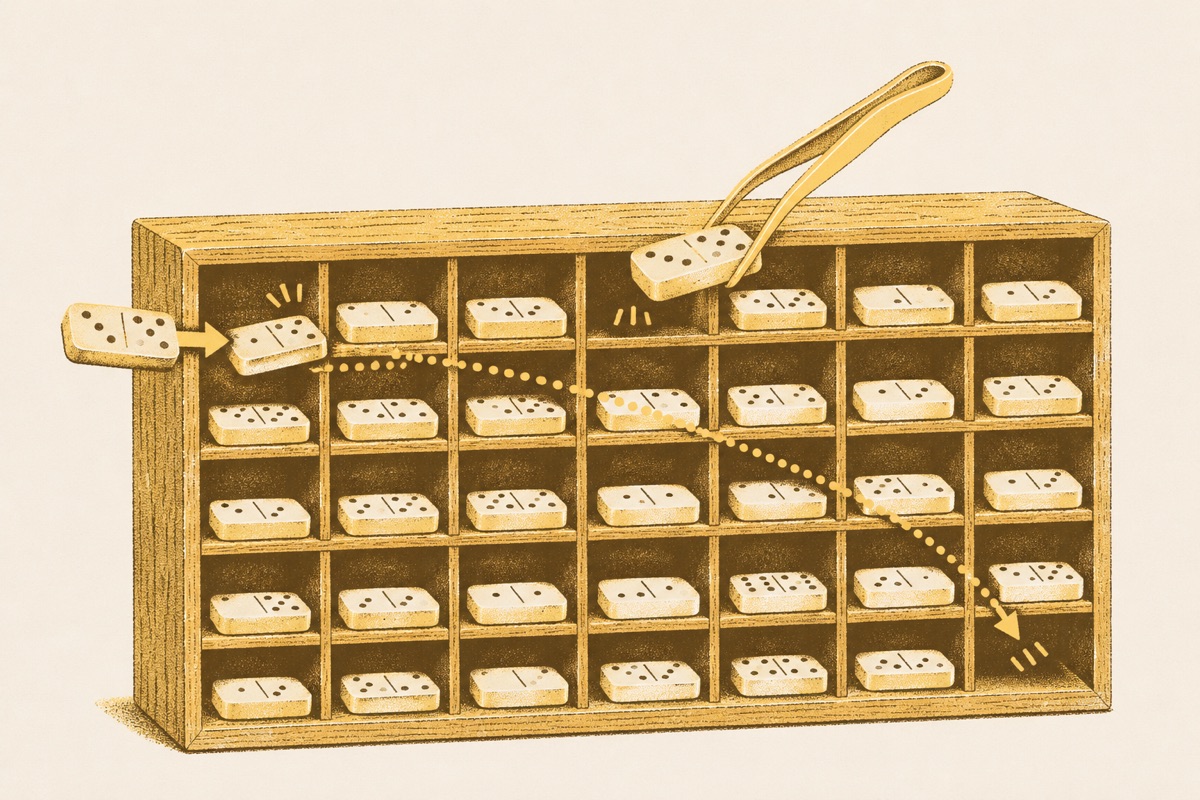
Two design choices make this formula resilient. First, reciprocal rank decays smoothly instead of exponentially, so top ranks carry the most weight without erasing documents ranked 10th or 30th across multiple systems. Second, the smoothing constant k = 60 caps the advantage of rank 1 (1/61 = 0.0164) over rank 4 (1/64 = 0.0156), preventing a single outlier system from hijacking the top slot while allowing agreement across two retrievers (2/64 = 0.0313) to outrank a solitary rank-1 hit (0.0164).
By contrast, Condorcet Fuse sorts documents by pairwise majority votes (r(d1) < r(d2)), which requires holding all lists in memory and lets a slim majority of mediocre systems outvote two systems that spot a strong result. CombMNZ (|{r | r(d) <= c}| * sum s_r(d)) depends directly on raw uncalibrated scores, causing erratic swings across datasets.
Key Findings
- Stability beats CombMNZ’s occasional edge: Although CombMNZ edged RRF slightly on TREC 3 (0.4381 vs. 0.4350) and LETOR 3 (0.6107 vs. 0.6051,
p = 0.2, not statistically significant), CombMNZ fell below the best individual system on TREC Robust (0.3575 vs. 0.3586) and TREC 9 (0.2671 vs. 0.2801). RRF beat Condorcet in every comparison and beat every automated individual system on every benchmark. - Diversity drives the lift: On LETOR 3, none of the five individual rank learners (ListNet, LGD, AdaRank-MAP, RankSVM, RankBoost) differed significantly from one another, yet RRF lifted MAP by +0.0205 to +0.0429 (
p < 0.003), approaching the roughly 65% ceiling attributed to human-adjudicated relevance on the collection. - Metric invariance: While the short SIGIR paper prints MAP for brevity, the authors note that
P@k, R-precision, and NDCG showed comparable improvements.
Caveats and Builder Takeaway
Original RRF has three blind spots that matter in modern hybrid search stacks. First, every list receives equal weight: adding three slightly tweaked BM25 queries alongside one dense vector search gives the lexical side three votes to one, tilting the ranking toward keyword matches. Second, candidate depth creates a hard cliff: when each retriever returns only its top 20 or top 50 hits, any document at rank 21 contributes zero rather than 1/81, so tuning k matters far less than choosing a wide enough per-retriever fetch limit. Third, the 2009 paper evaluated ensembles of 5 to 30+ systems; fusing just two retrievers (such as HyDE plus exact lexical search) provides less tie-breaking diversity, and if you also need non-redundant results, follow fusion with maximal marginal relevance.
Still, RRF’s zero-training simplicity makes it the right default first step whenever you combine incompatible rankers. Keep k = 60, verify that each constituent retriever pulls deep enough candidates (for example, top 100 before truncating to top 10), and only introduce learned weights or cross-encoder reranking once you measure gains against every single component on your own evaluation queries.